US market update provided by NutriQuest Business Solutions – not for further distribution
 On a monthly basis, we provide a more comprehensive review of key swine industry performance and profitability indicators, in addition to our normal weekly profitability updates. International Hog Prices We update international hog prices monthly and convert them to US dollars per carcass cwt (100 lbs.) for an accurate current comparison. There are some important trends worth mentioning. 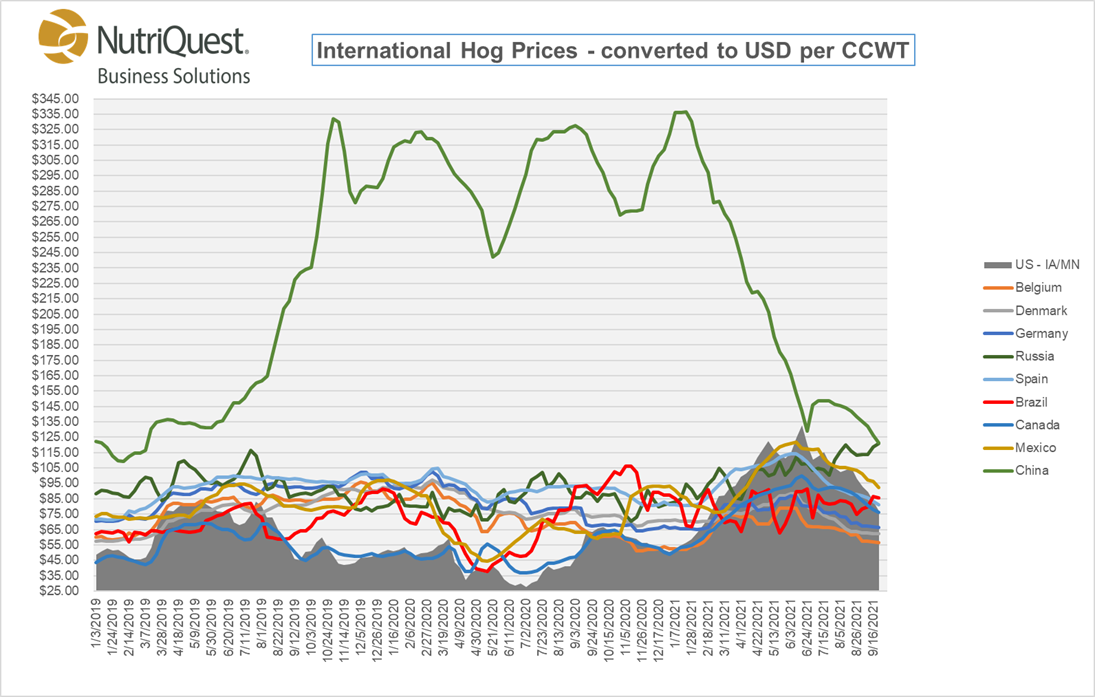 The U.S. price has declined seasonally since reaching its peak in June, and is surpassed by prices in China, Russia, and Mexico….and just barely surpassed by Brazil and Spain at the end of September. China’s sharp price decline for most of this year reversed slightly in July but has been slowly declining since and prices linger at pre-ASF levels. Though difficult to discern, likely a combination of increased African Swine Fever cases and economic liquidation, both prompting additional marketing volumes, in addition to real expansion in China have prompted this price moderation. Reports of economic liquidation among heavy (> $100/head) losses have recently resulted in an increase in China hog futures. Clearly, their prices will turn around – and likely soon – as their current situation is not sustainable. See the following graphic that is evidence of this: 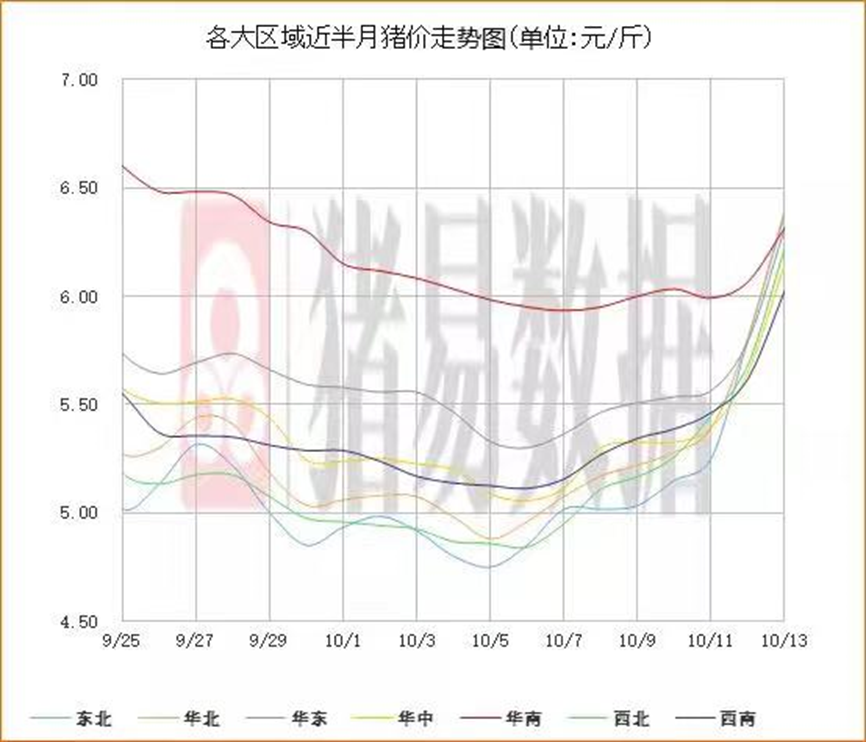 Interestingly, Russia’s price has increased and has now equal to China’s price, likely a result of a short-term shortage of market hogs due to ASF breaks earlier in the year. Prices for EU countries and Canada continued to decline in September and mostly remain lower than the U.S. price – combinations of lower hog price and relatively weaker currencies – although we see the gap narrowing this month as the U.S. saw a sharp price drop. Mexico’s price declined but remains higher than the U.S. The only countries that saw a price increase from last month was Russia and Brazil. Belgium, Denmark, and Germany producers have the lowest prices today, no doubt a result of ASF restricting exports from that region. U.S. Pricing Mechanisms Monthly, we also update data for three common pricing methodologies for independent producers of hogs, which had illustrated the disadvantage of being paid on a Western Corn Belt and, to a lesser extent, CME Lean Hog Index basis as compared to a cutout basis over recent years. This trend flipped in spring/summer 2021 with the reduction in slaughter numbers and strong demand. However, this relationship flipped back again recently, with a $5 to $10 per head disadvantage of WCB pricing, as slaughter numbers versus plant capacity have gotten tighter…this trend will likely continue over the coming months. 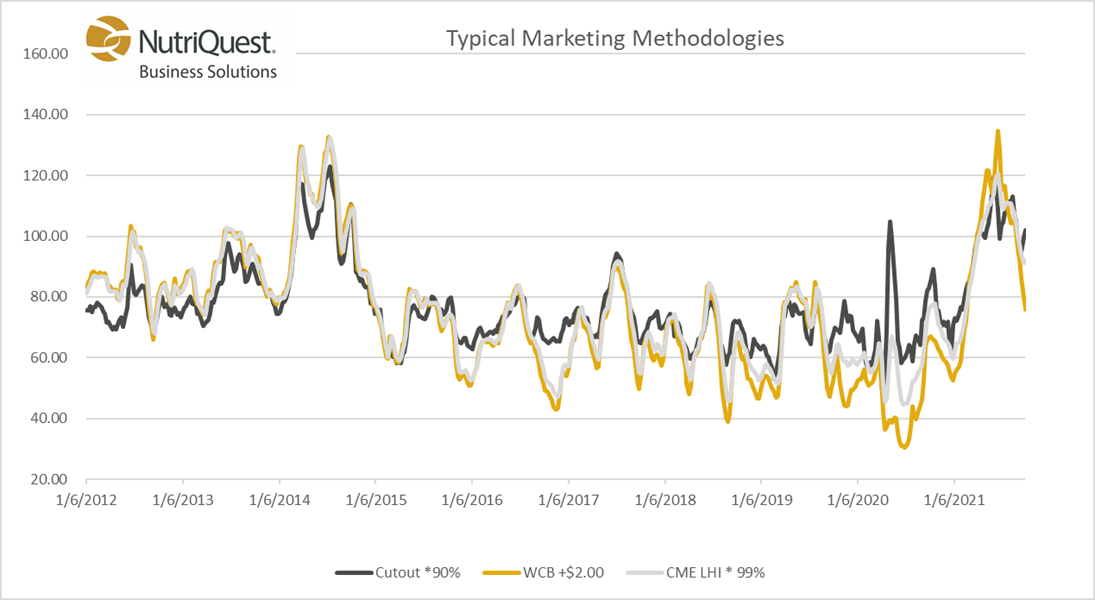  Prices and Packer Spreads Cutout decreased $5.67/cwt this week while the 201 Negotiated Average Hog Price decreased by $3.96/cwt, resulting in a $3.59/head decrease in packer spread/margin per head (before offal/variety meats). 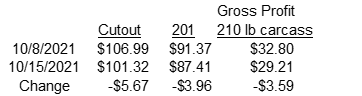 The packer spread decreased to $29.21 per head – compared to a 3-year average margin of $23.48 and 1-year average of $27.45. NOTE: Simply taking the Cutout less the 201 Average Hog Price is a misnomer of true packer margin. First, neither is likely representative of anyone packer’s true fresh pork or hog procurement pricing, and cutout reflects domestic sales only. Additionally, there is no revenue provision for offal/drop credit or any further processing, nor are there any processor operating costs. This information is intended to show an element of industry gross margin, primarily to track trends over time, but is not indicative of true packer profitability. 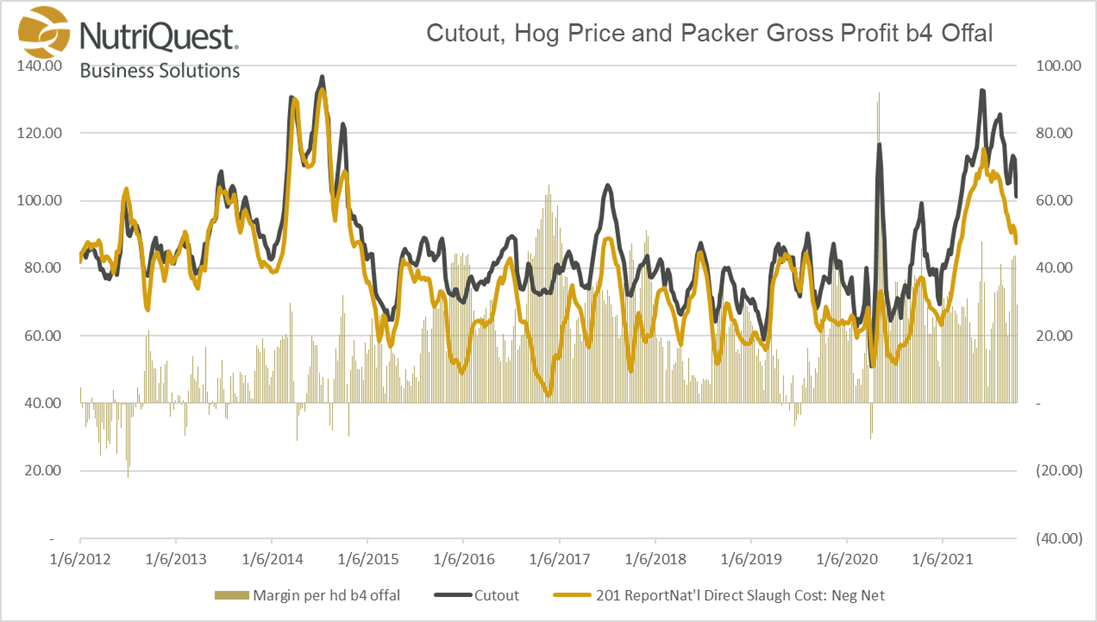 Below is a seasonal history from 2015 of the drop credit (offal) value per cwt. live according to USDA Report NQ_LS446. Note that this element is incremental to packer gross profit margins, and is at a historically high level, currently above 30% over last year and the historical average. 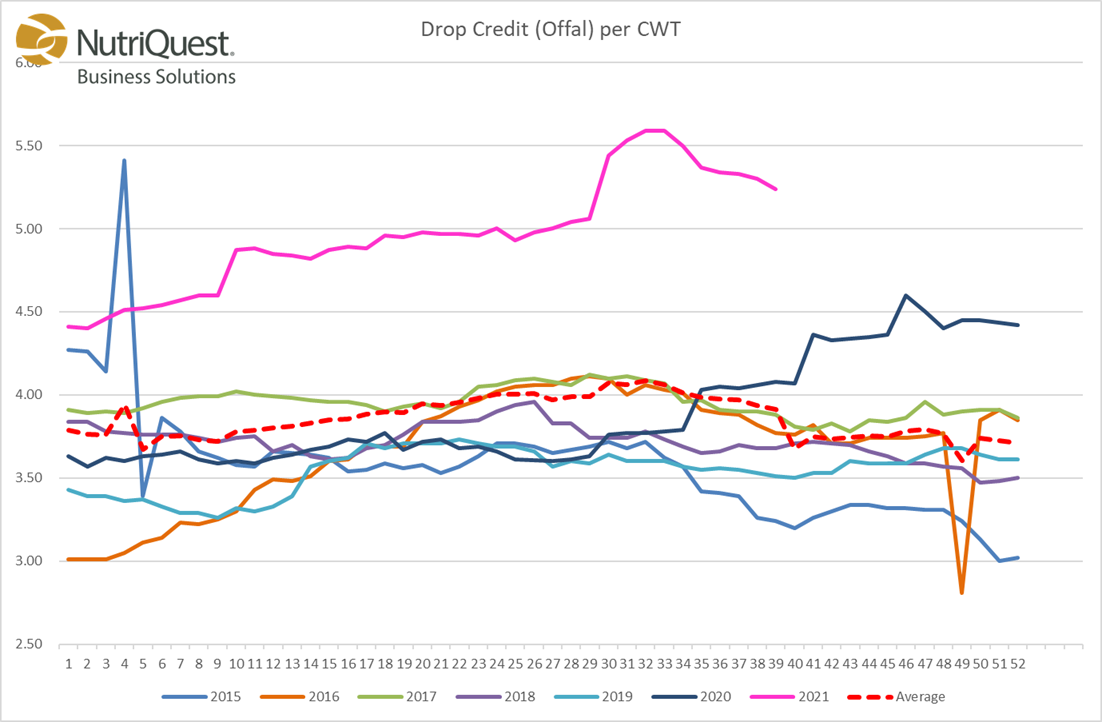 The graph that follows is a look at the historical seasonal relationship between the National Daily Base 201 and cutout, illustrating that current relationship is above the six-year average and exceeds all years presented, with the exception of 2018: 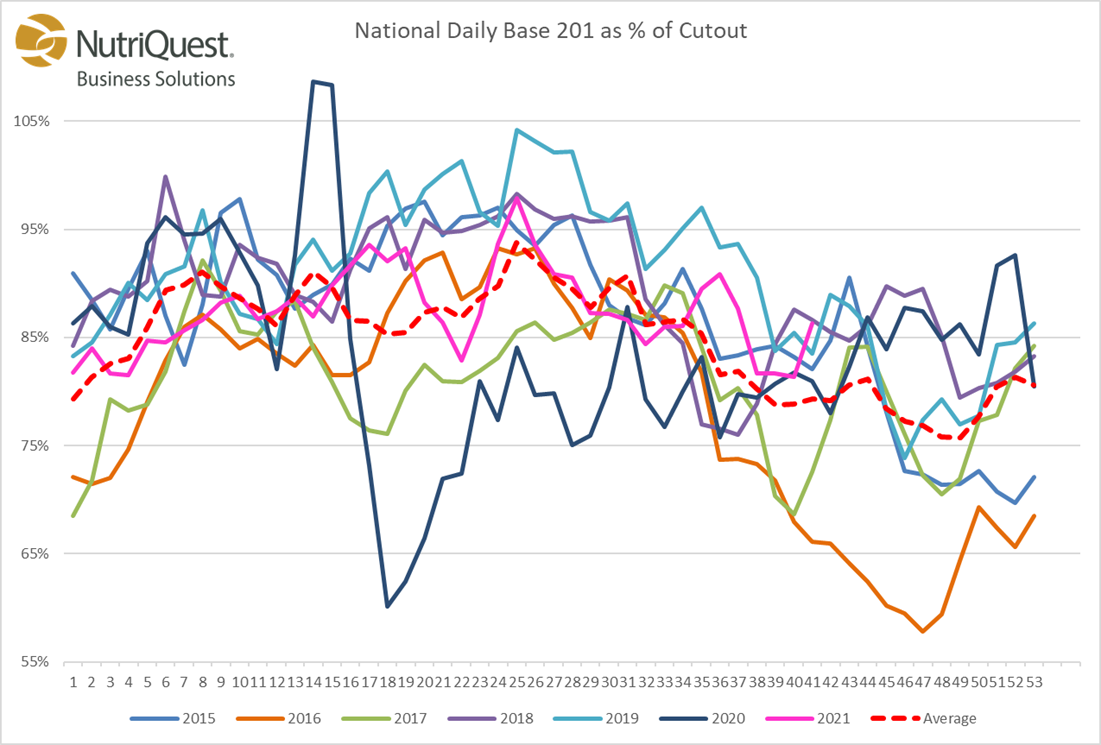 Hog Forward Margin This week brought more decline in lean hog futures, slightly offset with decreases in corn futures, which resulted in forward margins falling by $3.31 per head sold. 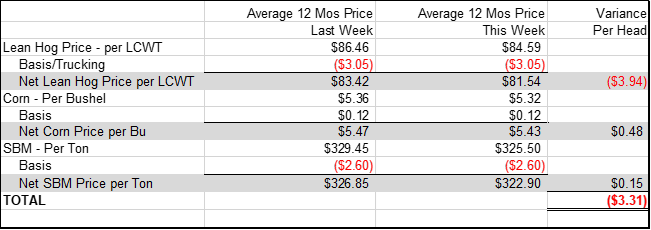 …decreasing 12-month-forward margins to a gain of $14.31 per head sold before financing and G&A costs (for a low-cost upper Midwest producer)… 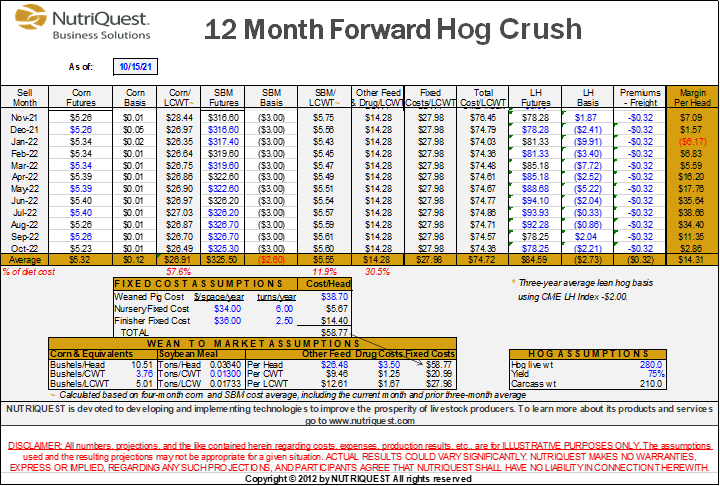 …ranging from a net gain of $4 to $9 per head sold on a bottom-line basis (for a low cost upper Midwest producer)…  … dipping below the historical average of margins since we began reporting this in 2008…  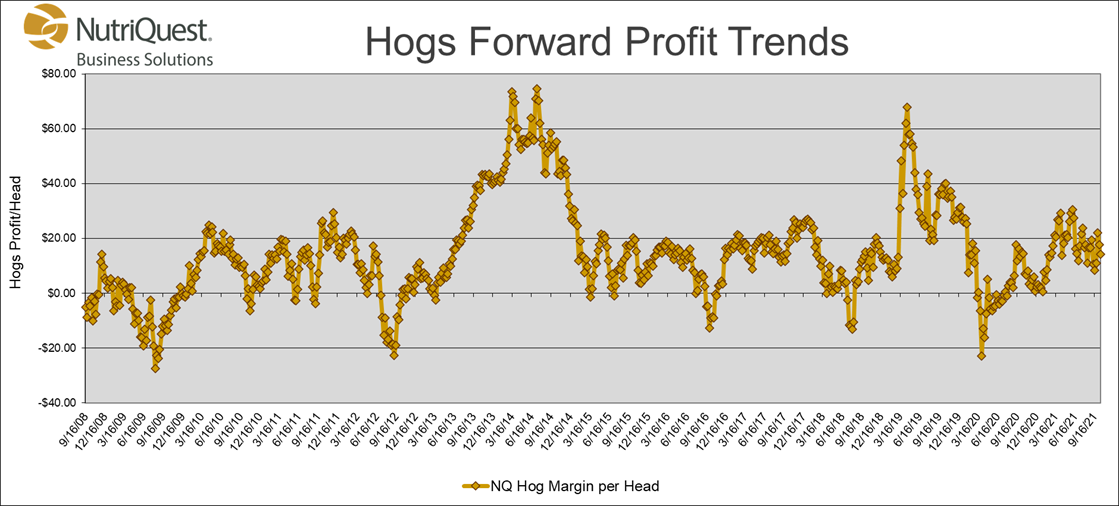 … and calendar 2022 forward margin decreased to $12.64 per head profit before financing and G&A (for a low-cost upper Midwest producer)… 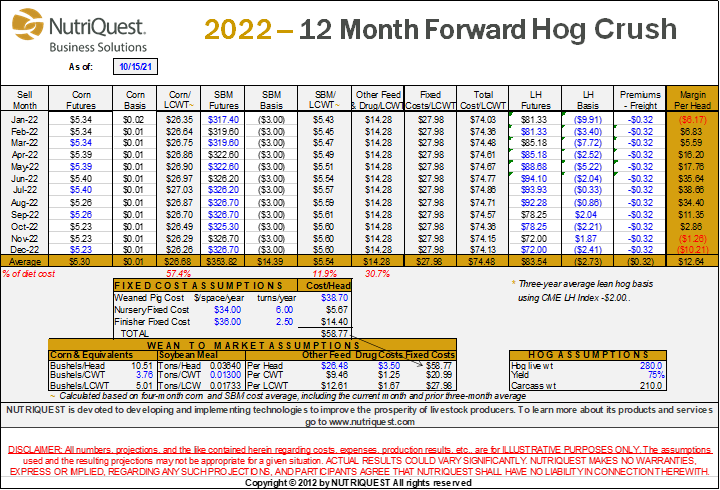 NutriQuest Business Solutions is a team of leading business and financial experts that bring years of unparalleled experience in the livestock, row-crop, and financial industries. At NutriQuest our success comes from helping producers realize improved profitability and sustainability through innovation driven by a relentless focus on helping producers succeed. For more information, please email our Directors at casey@nutriquest.com or Jenniferbrown@nutriquest.com. |